Italy Through The Senses: What Travel Can Teach Us About Sensory Intelligence®
Posted: 30 September, 2026
By: Annemarie Lombard
Share this post:





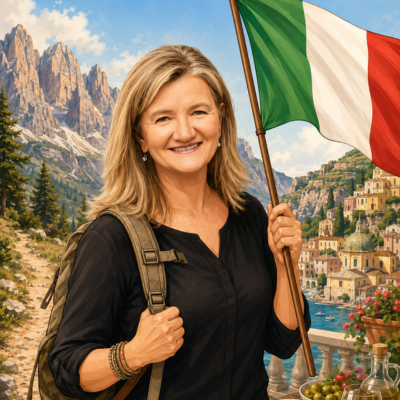
Travel is one of the most powerful ways to experience the world through our senses.
Recently, I spent three weeks travelling through Italy, ticking off a major bucket-list item and experiencing Venice, the Dolomites, Florence, Cinque Terre, and Rome.
Being the Sensory Intelligence® nerd that I am, I couldn’t help but reflect on the trip through my sensory framework.
Because travel isn’t simply about where we go, it is also about how we experience where we go.
Our sensory systems are constantly taking in information from our surroundings – what we see, hear, smell, taste and feel, as well as how we move through and interact with the environment.
And the fascinating thing is that not everyone experiences the same place the same way.
Here is how Italy showed up through my senses.
Vision: Italy Is A Feast For The Eyes
Italy certainly didn’t disappoint visually.
From the Colosseum and Sistine Chapel in Rome to the magnificent mountain peaks of the Dolomites, the canals of Venice, the Mediterranean coastline of Cinque Terre, and Michelangelo’s David in Florence, there was an extraordinary amount to see.
I was struck by how much history is still visible in the Italian landscape.
The colours, architecture, textures, shapes, patterns, and intricate details created a constant stream of visual information.
For my visual system, there was plenty to explore!
Auditory: Listening To Italy
Of course, there were the sounds of Italy itself. While exploring the streets, I heard conversations, traffic, footsteps, restaurants, busy streets, and crowds.
But I also created my own Italian summer playlist and listened to it throughout the trip.
And then there was the Italian language.
I don’t speak or understand Italian, but I loved listening to it.
There is something about the rhythm, tone, and musicality of a language that can connect us to a culture, even when we don’t understand the words.
Music and sound can become part of our memory of a place.
Smell: Not Everyone Experiences The Same Smells
Smell was particularly interesting for me.
I have a high smell threshold, which means I generally don’t notice subtle smells unless they are quite distinct.
When I first arrived in Venice, I immediately noticed the smell of water.
But for much of the rest of the trip, smells weren’t particularly prominent for me.
Rome did have one very memorable smell, though…
Sewage! 😂
And this is where individual sensory differences become fascinating.
Someone with a low sensory threshold for smell may have experienced Italy very differently from me, noticing far more subtle smells and nuances that simply didn’t register strongly in my sensory system.
Same environment.
Different sensory experience.
Taste: Italy As A Sensory Feast
This one was easy.
Italy was a feast!
Pizza. Pasta. Gelato. Tomatoes. Cheese. Prosciutto. Wine.
The food culture was extraordinary, and I loved exploring it.
I even did a pasta-making course in Florence. Making the pasta was great fun, but naturally, eating what we made afterwards was the highlight!
Food isn’t simply fuel. Taste, smell, texture, temperature, visual presentation, and the social experience of eating all contribute to how we experience food.
Italy certainly gave my taste system plenty to work with.
Touch: When The Temperature Becomes A Sensory Experience
My biggest sensory challenge in Italy was probably heat.
Coming from a winter environment, the Italian summer was a shock to my system.
With temperatures reaching around 35°C, particularly in Florence and Rome, the combination of heat, humidity, and crowds became challenging.
And I noticed something important:
Knowing my sensory needs allowed me to manage the experience differently.
I deliberately stayed in central accommodation so I could return during the day for a siesta, lie under the air conditioner, recover, and then head out again.
That wasn’t being lazy.
That was sensory self-management.
Instead of pushing through until I was completely depleted, I recognised what my system needed and responded to it.
Movement: Experiencing Italy On Foot
Italy is also a wonderful country for movement.
I walked a LOT.
Across the 21 days, I clocked up around 45,530 steps on average.
The Dolomites contributed significantly, with ten days of walking in the mountains, but I also walked extensively through the cities and even fitted in a few early-morning runs when the streets were quieter.
I came home fitter than I left.
Movement wasn’t simply exercise during this trip. It was part of how I experienced the environment.
Walking allowed me to slow down, explore, notice, and interact with the places I was visiting.
Multi-Sensory Experiences: Getting From A To B
And then there was the sheer variety of ways I travelled through Italy.
Planes.
Water taxis.
Gondolas.
Vaporettos.
Rental cars.
Trains.
Buses.
And, of course, plenty of walking.
Every mode of transport created a different sensory experience.
A water taxi through Venice is completely different from sitting on a train travelling through the Italian countryside.
Driving through the Dolomites is different again.
Our sensory experiences aren’t static. They constantly change as our environment changes.
The Sensory Contrast Between The Dolomites And The Cities
One of my favourite aspects of the trip was the contrast between the different environments.
The Dolomites were slower, calmer, and more spacious.
Venice, Florence, and Rome were much busier, more crowded, and stimulating.
As someone who enjoys sensory stimulation, I loved having both.
The quieter mountain environment gave me space to slow down and absorb the surroundings, while the cities offered an abundance of visual, auditory, movement, and social stimulation.
That variety was part of what made the trip so enjoyable.
Why Sensory Differences Matter When We Travel
Perhaps the biggest lesson I brought home was this:
Two people can travel to exactly the same destination and have completely different experiences.
One person may love the crowds, noise, heat, and constant stimulation.
Another may find the same environment exhausting.
One person may notice every smell coming from a restaurant, street, or canal.
Another may barely register them.
One person may be captivated by the visual detail of a historic city.
Another may find all that visual information overwhelming.
Neither experience is necessarily right or wrong.
They are simply different sensory experiences.
This is one of the fundamental ideas behind Sensory Intelligence®.
Our sensory systems influence what we notice, how we respond to our environments, and ultimately how we experience the world around us.
Same Italy. Different sensory systems. Different experiences.
Our senses really are the window through which we experience life.
And perhaps that’s one of the greatest gifts of travel: it reminds us that the world isn’t experienced objectively.
We experience the world through our own unique sensory systems.
So, the next time you travel, don’t just ask yourself:
Where am I going?
Also ask:
What am I experiencing through my senses, and what does my sensory system need to enjoy the journey?
Cheers to travelling! 🥂
You don’t need a plane ticket to discover something new about yourself. Complete the Sensory Matrix™ and start exploring your own sensory world today.